Resource Lesson |
|
|
|
When work is done by a conservative electric field on a test charge, then the charge will lose EPE and gain KE. This is written mathematically as WE field = - DEPE
= DKE Remember that work is calculated according to the formula: W = Fs cos q
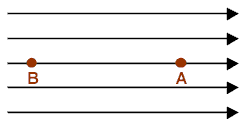
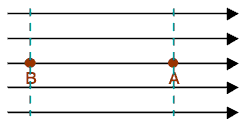
If a positive test charge, +q, is moved from point B to point A, along the direction of a field line, then the angle between F=qE and s equals 0º and the field does positive work on +q. This is evidenced by the fact that the point charge would gain KE as it reaches A. But the charge has lost electric potential energy since position B sits on a higher potential surface than position A.
The change in EPE equals +q (DV) = +q (VA - VB) = (+)(-) < 0
Suppose instead that a negative point charge is moved by the field from A to B. Does this work done by the field also represent a loss of EPE? Remember that in uniform fields, field lines point from the positive plate to the negative plate. Therefore, equipotential surface A is closer to the negative plate and therefore represents a position of higher potential energy for a negative charge. The field would naturally accelerate a negative test charge from surface A to surface B, so F and s point in the same direction, making q = 0º. W = Fs cos q > 0, but DEPE = -q (VB - VA) = (-)(+) < 0 |
| Copyright © 1997-2026 Catharine H. Colwell All rights reserved. PhysicsLAB Mainland High School Daytona Beach, FL 32114 |